





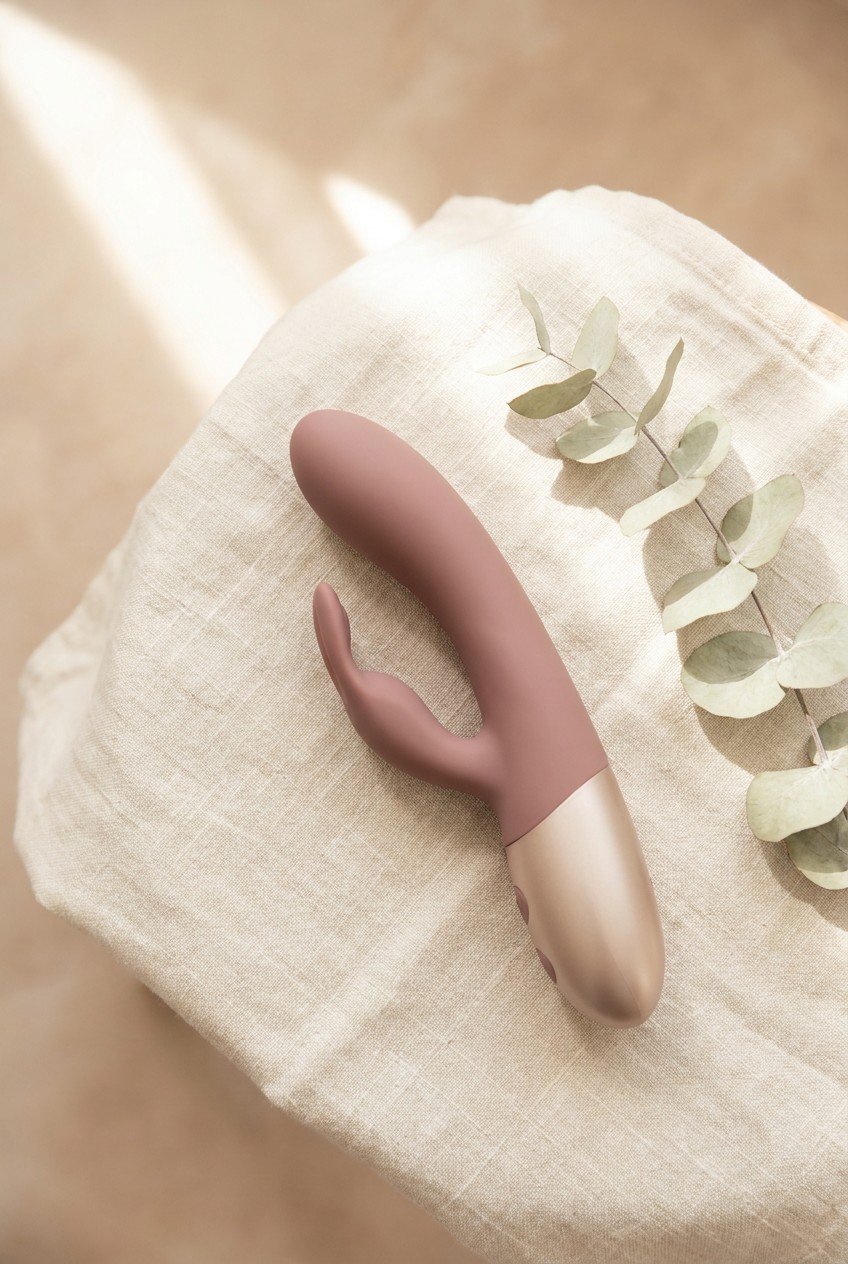
If you could only save one sex toy design from a burning building, it would be the rabbit.
Not because it’s the newest. Not because it’s the most expensive. Because it’s the only design in the history of sex toys that solved a genuine anatomical problem so well that the solution became a cultural icon — and then kept improving for three decades while most competitors came and went.
The rabbit vibrator was introduced in the 1980s, catapulted into mainstream consciousness by Sex and the City in 1998, and has been the best-selling vibrator category in the Western world for most of the years since. That’s not marketing. That’s a design so effective it transcended its own industry.
This guide isn’t a product list. There are already hundreds of “Top 10 Rabbit Vibrators” articles that tell you which ones to buy without telling you why any of them work. This is the buyer’s manual — the anatomy lesson, the parameter checklist, and the positioning technique that separates a good experience from a frustrating one.
Let’s start with the question the product lists skip: what makes this shape different from every other vibrator?
A rabbit vibrator does two things simultaneously that most vibrators can only do one at a time:
Here’s why this matters anatomically. The clitoris isn’t just the small external nub you can see. It’s a wishbone-shaped internal organ with branches that extend down both sides of the vulva and wrap around the vaginal canal. The G-spot isn’t a separate structure — it’s the internal portion of the clitoris, accessible through the vaginal wall.
When you stimulate both the external clitoris and the internal G-spot simultaneously, you’re not getting two separate sensations. You’re stimulating different parts of the same nerve network from two directions at once. The result isn’t 1 + 1 = 2. It’s closer to 1 + 1 = 4.
That’s the rabbit’s secret. The shape isn’t a gimmick. It’s a solution to the problem that most vibrators force you to choose — inside or outside, but not both at once.
This distinction matters more for rabbits than for any other vibrator type.
Single-motor rabbits route vibration from one motor through both the shaft and the ears. The frequency is synchronized — both contact points vibrate at the same speed at the same time. This is simpler, cheaper, and works well for people who don’t need independent control.
Dual-motor rabbits have separate motors for the shaft and the ears. This means you can set different intensities for each. For example: lower vibration on the G-spot shaft (internal sensitivity varies) and higher vibration on the ears (clitoral stimulation typically benefits from more intensity). This flexibility is the main reason dual-motor rabbits command higher prices.
Which should you choose? If you’ve never used a rabbit before, a single-motor model is fine for learning. But if you already know your preferences — for example, you know your G-spot is more responsive than your clitoris — the dual-motor upgrade is worth the money.
The sex toy industry produces novelty shapes constantly. Most vanish within 18 months. The rabbit has survived 30+ years because:
Skip the marketing copy. These are the only six things that matter.
The ears are where most rabbits succeed or fail for an individual user. Clitoral anatomy varies enormously — some clitorises sit higher, some lower, some are more sensitive than others.
Flexible ears bend to accommodate your anatomy. If you’re not sure where your clitoris sits relative to a toy, or you’ve had alignment issues with other rabbits, flexible ears are the safer bet.
Fixed ears stay in position and deliver more concentrated stimulation. If you know exactly where your clitoris is and you’ve used rabbits before without alignment problems, fixed ears can feel more intense.
Vibrating tongue is a newer design where a small, flat protrusion replaces the traditional dual-ear shape. It concentrates vibration on a smaller surface area — better for pinpoint stimulation, less forgiving if the angle is off.
The practical test: If you can’t try a rabbit before buying, start with flexible ears. You can always upgrade to a more targeted design later. Starting with fixed ears and getting the alignment wrong leads directly to “rabbit vibrators don’t work for me” — which is almost always a positioning problem, not a product problem.
The internal shaft needs to curve toward the front wall of your vagina — where the G-spot lives. That’s non-negotiable.
The sweet spot: 15° to 30° of curvature, with the bend occurring in the front third of the shaft. This matches the typical location of the G-spot, which is roughly 2–3 inches inside the vaginal canal on the front wall.
Too straight → the tip misses the G-spot entirely and presses into the back wall. You get internal vibration but no targeted stimulation.
Too curved → insertion becomes difficult and the shaft may feel like it’s hooking uncomfortably.
What to look for in product photos: A side profile image. The shaft should visibly curve forward (toward the same direction as the ears). If the shaft looks straight or only curves at the very tip, skip it.
Rabbit dimensions are more important than for any other vibrator type, because the toy has to fit both your internal anatomy and your external anatomy simultaneously. Two measurements matter:
Insertable diameter: 1.2–1.5 inches (3–3.8 cm) is the comfort zone for most people. Rabbits tend to run narrower than dedicated G-spot toys because the external component means you don’t need “fullness” from the shaft alone.
Insertable length: 4–5 inches (10–12.7 cm). The G-spot is 2–3 inches in. Anything longer than 5 inches is unnecessary for stimulation and may interfere with ear alignment — a longer shaft pushes the ears past your clitoris.
The oversize trap: Some rabbits are marketed with “extra-large” shafts as a premium feature. For most users, this is counterproductive. The rabbit experience depends on precise alignment between ears and clitoris — a larger shaft makes that alignment harder to maintain, not easier.
This one is straightforward: medical-grade silicone or nothing.
Silicone is non-porous. It doesn’t absorb bacteria, doesn’t degrade with proper cleaning, and doesn’t leach chemicals. For a toy that contacts both the vaginal canal and the highly sensitive clitoral area, this is not optional.
TPE (thermoplastic elastomer) is softer and cheaper, but porous. Bacteria penetrate the material surface and cannot be fully removed. The same goes for jelly rubber, PVC, and any material described as “skin-like” or “real-feel” without specifying medical-grade silicone.
ABS plastic is sometimes used for the handle or control section. That’s fine — it’s rigid, non-porous, and doesn’t contact mucosa.
The rabbit-specific concern: The ear section is in constant contact with the clitoris, which has a higher concentration of nerve endings than any other external body part. Irritation from low-quality material here is more noticeable and more painful than on other body regions. Don’t compromise on material for a rabbit.
Go deeper: Material safety matters for every toy in your collection, not just rabbits. See our complete guide to body-safe sex toy materials for a breakdown of silicone, TPE, ABS, and what to avoid at any price point.
IPX7 is the minimum. Anything less, and you’re risking water ingress through the seams where the shaft meets the handle and where the ears attach. Rabbits have more seams than simpler vibrator shapes, and each seam is a potential failure point.
IPX7 means: submersion in 1 meter of water for 30 minutes without damage. It’s the standard for shower- and bath-safe toys.
IPX6 or lower means: splash-resistant, not submersible. Fine for cleaning, risky for bath use.
Why waterproof matters specifically for rabbits: The rabbit’s shape makes accidental water ingress more consequential. Water trapped inside a sealed rabbit can breed mold you’ll never see. If you plan to use your rabbit in a bath or shower, check the IPX rating on the product page. If it doesn’t explicitly say IPX7, it isn’t.
Dual motors produce more sound than a single motor. That’s physics, not a design flaw.
Acceptable range for a rabbit: 50–55 dB at maximum speed. For reference, normal conversation is about 60 dB. A quiet rabbit should be audible in a silent room but not through a closed door.
Above 60 dB: You’ll hear it through walls. This is common on budget single-motor models where the single motor is overdriven to compensate for the lack of dual motors.
Below 50 dB: Rare, usually only on premium models with sound-dampened motor housings. Nice but not essential.
What you get: Single motor, 3–5 vibration patterns, silicone coating over an ABS core. Water-resistant (IPX6) at best. The ears are almost always fixed.
Who it’s for: Someone who’s never used a rabbit before and doesn’t know if they’ll like dual stimulation at all. This tier is for testing the concept, not finding your permanent rabbit.
The catch: Fixed ears at this price point tend to be stiff. If your anatomy doesn’t match the factory’s default angle, the experience will be underwhelming — not because rabbit vibrators don’t work, but because this rabbit doesn’t fit you.
What you get: Dual motors, independent ear and shaft controls, 7–10 patterns, IPX7 waterproofing, and flexible ears. This is the sweet spot.
Who it’s for: Most buyers. The performance jump from 50to80 is the largest in the entire rabbit category. At this tier, you’re getting the actual rabbit experience — independent control, flexible fit, and waterproofing — without paying for brand markup or app connectivity you may never use.
What to look for: Dual motors confirmed in the specs. “Silent” or “whisper” in the noise description. A charging case or magnetic charger rather than a DC plug (which creates a larger seam).
What you get: Everything in mid-range, plus app control, customizable patterns, memory settings, and travel locks. Brand prestige and packaging quality increase significantly.
Who it’s for: Someone who already knows they love rabbits and wants the fully customizable experience. Or someone who values the app-control feature for long-distance partner play.
The honest assessment: The core physical experience — what the toy actually feels like — does not double between a 90rabbitanda180 rabbit. What doubles is the software, the packaging, and the brand story. Buy premium for the app and the customization. Don’t buy premium expecting twice the sensation.
Most first-time rabbit experiences fail for the same reason: the user inserts the shaft fully and expects the ears to land on the clitoris automatically. They usually don’t. The ears end up too high, too low, or off to one side, delivering weak or no stimulation. The user concludes that rabbits are overhyped. They’re not — they’re just dependent on positioning.
Here’s the correct sequence:
Do not insert the shaft yet. Apply lubricant to the ears. Turn the rabbit on at the lowest intensity. Place the ears against your clitoris — not above it, not below it, directly on it. Adjust the angle subtly until you feel the most responsive contact point.
This step teaches you where your clitoris is relative to the ears. If you skip it and insert immediately, you’re guessing. Guessing with a rabbit wastes the session.
Apply lubricant to the shaft. Insert with the ears pointing up — toward your belly button, not toward your spine. This orients the curved shaft toward the front vaginal wall.
Push in slowly, about 2–3 inches. Pause. Look down or use a mirror: where are the ears relative to your clitoris?
If the ears are above your clitoris → pull the shaft out slightly, not push deeper. The most common positioning error is inserting the rabbit too far, which pushes the ears past the clitoris. A shallower insertion almost always fixes this.
If the ears are below your clitoris → push in slightly more, or rotate the shaft a few degrees.
If the ears are off to one side → rotate the handle gently until the ears center.
Place one finger against your clitoris while the rabbit is inserted. If you can feel both the ears vibrating and your finger touching your clitoris simultaneously, you’re in position. If you feel the vibration through your finger but not on your clitoris, the ears aren’t making direct contact — pull out slightly and readjust.
Do not turn the vibration up yet. At this stage, your clitoris is adjusting to a new sensation — even a familiar one delivered through a new mechanism. Give it 30–60 seconds on low before gradually increasing. Jumping to maximum speed on first contact is the second most common reason people reject rabbits.
Once the rabbit is positioned and you’re comfortable, your hips will start moving. That’s good — natural pelvic motion shifts the contact angle subtly and rhythmically. Do not fight this by holding perfectly still. The rabbit is designed to move with you.
| Problem | Likely Cause | Fix |
|---|---|---|
| Ears not making contact | Inserted too deep | Pull out 0.5–1 inch |
| Ears pressing too hard | Inserted too shallow | Push in 0.5–1 inch |
| Vibration feels “muddy” or weak | Battery low (common on new toys shipped with partial charge) | Charge fully before first use |
| Shaft feels uncomfortable | Not enough lube or too large | Add lube; if still uncomfortable, size down next purchase |
| Ears pinch or chafe | Fixed ears + anatomy mismatch | Switch to flexible-ear model |
Rabbits have more surface complexity than any other common vibrator type: ears, a curved shaft, a junction between the two, plus seams around the control buttons and charging port. Each of these is a place lubricant and bacteria can accumulate. (For cleaning fundamentals that apply to every toy type, start with our step-by-step vibrator cleaning guide.)
Same principle as all insertable toys: do not use a rabbit for anal play and then vaginal play in the same session without thorough cleaning. Ideally, don’t use the same rabbit for both at all — the complex shape makes complete sterilization between uses harder than with a smooth vibrator.
No — if you start correctly. Low intensity, external ears only for the first 2–3 minutes, lubricant applied generously, and no pressure to insert the shaft until you’re ready. The rabbit’s reputation for intensity comes from people who inserted immediately on maximum speed. The tool isn’t the problem. The approach is.
Apart. With your thighs together, the rabbit’s ears get pushed away from your clitoris, and the shaft angle shifts. A comfortable spread-leg position — pillows under your knees if you’re on your back — gives the rabbit room to sit correctly.
Yes. Turn off the ear motor if you have a dual-motor model, or remove the ear attachment if your model is modular. The shaft functions as a curved G-spot vibrator. This is useful if you’re in the mood for internal-only stimulation or if your clitoris is oversensitive that day.
Yes, but with a caveat. Rabbits require precise positioning, and partnered sex involves movement that makes precise positioning harder to maintain. The most reliable approach: let your partner use the rabbit on you during foreplay — orally, manually, or simply watching and learning your responses. Remove it when you move to intercourse. Trying to keep a rabbit in position during thrusting usually frustrates both people.
Three common causes in order of likelihood:
Water damage from shower/bath use with an IPX6 or lower rating. The seam seals degrade.
Charging port corrosion from storing the toy in a humid bathroom. Keep it in a dry drawer or pouch.
Motor burnout on budget single-motor models that were overdriven to compensate for the lack of dual motors.
A quality rabbit with IPX7 rating and proper storage should last 2–3 years of regular use.
The rabbit vibrator is the only sex toy design that moved from novelty to cultural icon to genuinely effective tool. That path wasn’t an accident. It happened because the shape solves an actual physiological problem — how to stimulate two pleasure zones at once without needing two hands or two toys.
If you’ve tried a rabbit before and it didn’t work, the odds are high that the issue was positioning, not the product. Most rabbits fail because of depth — too deep, ears miss the clitoris; too shallow, shaft misses the G-spot. Finding the right depth for your body takes one or two sessions of deliberate adjustment. After that, it becomes automatic.
If you’ve never tried one, start with the mid-range. 70–90getsyoudualmotors,flexibleears,andIPX7waterproofing—thefullrabbitexperienceatthepricepointwhereperformancepeaksrelativetocost.Youcanspendmore.Thejumpfrom50 to 90mattersmorethanthejumpfrom90 to $180.
Ready to find yours? Browse our rabbit vibrator collection — every model body-safe, every feature tested by real users, no judgment.
About the Author:
Dr. Yuki Tanaka is a sexual health educator and pleasure researcher at AmorSerere. With a PhD in human sexuality and 8 years of clinical education experience, Dr. Tanaka writes about sexual wellness from a medically grounded, stigma-free perspective. Her approach: precise information, zero condescension, and an unwavering belief that understanding your own body is the most underrated skill in human sexuality.
Last Updated: July 7, 2026

Clinical sex educator with 10+ years experience. Specializes in body-safe materials and sexual wellness education.