




In 2018, a Danish consumer agency tested 44 sex toys purchased from European retailers. They found phthalates — a class of chemical plasticizers linked to hormone disruption, reproductive damage, and developmental issues — in 6 of them. These were products sold legally, in a regulated market, by recognizable brands.
The sex toy industry is not regulated like the medical device industry. A product labeled “body-safe” on Amazon has undergone exactly zero required safety testing before that label was applied. A vibrator described as “medical-grade silicone” might be silicone on the tip and mystery jelly on the handle, with no legal consequence for the discrepancy.
This is not a reason to avoid sex toys. It’s a reason to know what you’re buying.
This guide explains every material used in sex toys — what’s safe, what’s risky, what’s outright dangerous, and how to tell the difference before you give a company your credit card. Every claim is grounded in material science. Nothing is based on “I read somewhere that—”
Before discussing specific materials, you need to understand the two properties that determine whether a material is safe for genital contact.
Non-porous materials have a surface that is smooth at the microscopic level. Bacteria, yeast, and mold cannot penetrate the surface. They can sit on top of it — which is why cleaning is still necessary — but they can’t move inside. Boiling water, bleach solution, or simple soap and water will fully sterilize the surface.
Porous materials have microscopic holes, channels, or gaps in their surface structure. Bacteria enter these gaps. Once inside, they cannot be reached by surface cleaning. Soap and water kill the bacteria on the surface but leave the bacteria inside alive. Over time, the material becomes a bacterial reservoir. Each use reintroduces bacteria to the body.
Why this matters: A porous toy cannot be fully sterilized. Ever. No amount of cleaning — not boiling, not bleach, not UV sterilization — reaches bacteria that have migrated below the surface. A porous toy that’s been used for six months has accumulated six months of bacteria inside its material matrix. You’re not cleaning it. You’re rinsing the surface and putting it back.
Chemically stable materials do not break down under normal use conditions. They don’t react with lubricant, body heat, cleaning products, or other toys stored nearby. Their molecular structure remains intact.
Chemically unstable materials contain plasticizers — softening chemicals — that are not chemically bonded to the base polymer. These plasticizers migrate out of the material over time. They leach into lubricant. They absorb through mucous membranes — the vagina, the rectum, the mouth. The mucosa is designed to absorb substances, which is why medications are sometimes administered vaginally or rectally. It’s excellent at absorption. Including the absorption of whatever your toy is made of.
Why this matters: A toy leaches chemicals the entire time it’s in contact with your body. Every use. Every minute of contact. You can’t feel it happening. You can’t see it. The toy looks exactly the same on day 300 as it did on day 1. The difference is inside the material, not on its surface.
What it is: A synthetic polymer made from silicon (sand), oxygen, carbon, and hydrogen. The silicon-oxygen backbone makes it chemically stable — it doesn’t react with lubricants, cleaning products, or biological tissue.
Porosity: Non-porous. Bacteria cannot penetrate the surface.
Chemical stability: Extremely high. Medical-grade silicone does not contain plasticizers. It does not leach. It is the same material used in medical implants, catheters, and infant feeding products.
Grades: Not all silicone is equal. “Silicone” on a product label means nothing by itself. The grades that matter:
| Grade | What It Means | Used In |
|---|---|---|
| Medical-grade / USP Class VI | Passes biocompatibility testing for implantation and prolonged mucosal contact. The highest standard. | Premium sex toys, medical implants |
| Food-grade | Safe for food contact but not certified for prolonged mucosal contact. Lower purity standards. | Budget toys labeled “100% silicone” |
| Industrial-grade | Not intended for human contact. Contains fillers, impurities. | Cheap toys mislabeled as silicone |
How it feels: Smooth, velvety, slightly grippy when dry. Body heat warms it within 30–60 seconds. It has a slight drag — lubricant is recommended. It’s flexible but not stretchy; you can bend it, but it returns to its original shape.
Cleaning: Soap and warm water, or boil for 5–10 minutes, or wipe with a 10% bleach solution, or run through the dishwasher (top rack, no detergent). Silicone tolerates every sterilization method.
Storage: Must not touch other silicone toys. Silicone-on-silicone contact causes molecular interdiffusion — the surfaces bond permanently over time. Each silicone toy needs its own pouch or compartment.
Lubricant compatibility: Water-based lubricant only. Silicone-based lubricant bonds with the silicone surface, creating a permanent sticky layer that cannot be cleaned off. This is the most expensive mistake new toy owners make.
Durability: 5–10 years with proper care. Silicone does not degrade from age alone. It fails from improper storage (touching other silicone, stored with TPE) or incompatible lubricant.
How to verify you’re getting real silicone: The flame test. Touch a lighter to an inconspicuous area of the toy. Real silicone will leave gray-white ash. It will not melt, drip, or produce black smoke. A toy that melts under a lighter flame is not silicone. This test destroys the tested spot — do it on the base or charging port area, not the functional surface.
What it is: Acrylonitrile butadiene styrene — a rigid thermoplastic used in everything from LEGO bricks to automotive parts. In sex toys, it’s used for bullet vibrator bodies, control panels, handles, and the internal chassis of silicone-coated toys.
Porosity: Non-porous. Hard, smooth surface that bacteria cannot penetrate.
Chemical stability: High. ABS is chemically stable and does not contain plasticizers. It’s approved for food contact and children’s products.
How it feels: Hard, smooth, cool to the touch. Takes longer to warm up than silicone, but once warm, holds temperature. No flexibility — it’s rigid.
Where it appears in your toy: Most vibrators have an ABS core underneath a silicone coating. The control buttons, charging port housing, and sometimes the handle are exposed ABS. If a part of your toy is shiny, hard plastic, it’s almost certainly ABS.
Cleaning: Soap and water. Do not boil — ABS can warp at high temperatures. No bleach — bleach etches ABS surfaces over time.
Storage: Safe to touch any other material. ABS is chemically inert and won’t react with silicone, TPE, glass, or metal.
Lubricant compatibility: Compatible with all lubricant types. ABS is impervious to silicone-based lubricants.
Safety note: Some cheap ABS contains bisphenol A (BPA) — an endocrine disruptor. Premium sex toy manufacturers use BPA-free ABS. If a toy is labeled “body-safe ABS” from a reputable brand, it’s BPA-free. If it’s $8 on Amazon with no material certification, assume it’s not.
What it is: The same glass used in laboratory beakers and high-end cookware. It’s annealed (slowly cooled) to remove internal stress, making it resistant to thermal shock and mechanical impact.
Porosity: Zero. Glass is completely non-porous at the atomic level. Nothing penetrates it.
Chemical stability: Absolute. Glass does not leach. It does not react with anything. It is the most chemically inert material used in sex toys.
How it feels: Heavy. Cool on insertion — this is either a feature or a drawback depending on preference. It warms to body temperature within 2–3 minutes and holds heat longer than silicone. Extremely smooth — lower friction than any other material, so less lubricant is needed.
Types:
Cleaning: Indestructible to cleaning methods. Boil it. Bleach it. Dishwasher it. Autoclave it (if you have access to one). Nothing damages glass.
Storage: Safe with any material. Can scratch ABS if the glass has edges, but glass itself won’t be scratched by anything in your drawer.
Lubricant compatibility: Compatible with all lubricant types. The glass surface is so smooth that less lubricant is needed than with silicone.
Safety concern: Glass toys must be annealed. An un-annealed glass toy can shatter under thermal stress (hot water to cold surface) or mechanical stress (dropping). Buy from reputable brands that specify “annealed borosilicate glass.” Do not buy glass sex toys from unfamiliar sellers on Amazon or AliExpress. A shattered glass toy inside a body cavity is a surgical emergency.
Durability: Decades. Glass doesn’t age, degrade, or wear. It breaks only from impact or thermal shock.
What it is: Surgical-grade stainless steel — typically 316 or 316L grade. The same material used for surgical instruments, body jewelry, and medical implants.
Porosity: Zero. Polished stainless steel is non-porous.
Chemical stability: Absolute. Steel does not leach, react, or degrade. It’s the most durable material in this guide.
How it feels: The heaviest toy material. Significant weight in the hand and inside the body — this is either luxurious or uncomfortable depending on preference. Cool on insertion. Warms to body temperature within 3–5 minutes and holds heat longer than any other material. Completely smooth when polished.
Cleaning: Indestructible. Boil, bleach, dishwasher, autoclave. Nothing harms stainless steel.
Storage: Safe with any material. Can scratch ABS and glass if edges are rough, but steel itself is impervious.
Lubricant compatibility: Compatible with all lubricant types. Less lubricant needed than with silicone.
Safety concern: Not all “metal” toys are stainless steel. Cheap metal toys are often chrome-plated zinc or nickel alloys. The plating wears off over time, exposing the base metal, which can contain nickel (a common allergen) and other irritants. If a metal toy is magnetic, it’s not surgical-grade stainless steel — 316 stainless is non-magnetic. If it’s suspiciously cheap, it’s not stainless steel. A quality stainless steel dildo costs 80+.A20 “stainless steel” toy from a brand you’ve never heard of is chrome-plated mystery metal.
Durability: A lifetime. Your grandchildren could inherit it.
What it is: A blend of plastic and rubber that’s softer and cheaper than silicone. It’s the most common material in budget sex toys — masturbation sleeves, realistic dildos, penis rings, and the soft outer layer of cheap vibrators.
Porosity: Porous. Deeply porous. TPE absorbs bacteria, yeast, and bodily fluids into its material matrix. Surface cleaning is cosmetic — it makes the toy look clean without actually making it clean.
Chemical stability: Unstable. TPE requires plasticizers to maintain its softness. These plasticizers are not bonded to the polymer. They leach continuously — more rapidly with heat, lubricant, and friction. Many TPE formulations contain phthalates, the endocrine-disrupting chemicals banned from children’s toys in dozens of countries but still legal in adult sex toys in most of the world.
How it feels: Very soft. Squishy. Often described as “skin-like” or “real-feel.” It’s warmer than silicone on initial contact. These sensory qualities are the reason TPE sells — it feels better in your hand than silicone does. The problem is that what makes it feel good is also what makes it unsafe.
The degradation timeline: A TPE toy has a finite lifespan measured in months, not years. After 3–6 months of regular use:
At this point, the toy is waste. You cannot clean it back to safe condition. The bacteria inside the material are permanent residents.
When TPE might be acceptable: External-use-only toys, used with a condom, replaced every 3–6 months. This is not a recommendation. It’s harm reduction for people who can’t afford or don’t have access to silicone alternatives. A TPE masturbation sleeve used externally with a condom is lower risk than a TPE dildo inserted into a body cavity without a barrier. But “lower risk” is not “safe.”
The honest truth: If you can afford silicone, buy silicone. If you already own TPE toys, start replacing them with silicone equivalents as budget allows. The money you save buying TPE is paid back in shorter toy lifespan and higher infection risk.
What it is: A rigid plastic that’s been softened with high concentrations of plasticizers to create “jelly” or “cyberskin” textures. PVC is the base material for the cheapest, most dangerous sex toys on the market.
Porosity: Extremely porous. PVC is the worst material in this guide for bacterial absorption.
Chemical stability: Terrible. PVC requires 30–50% plasticizer content by weight to achieve sex-toy softness. These plasticizers — historically phthalates, now often alternative plasticizers with unknown safety profiles — leach continuously. PVC toys also off-gas volatile organic compounds (VOCs) detectable by smell. That “new toy smell” is VOCs entering your respiratory system.
How it feels: Extremely soft, squishy, and often translucent or jelly-like. Visually appealing in the packaging. The sensory experience is designed to sell. The health implications are designed to be invisible.
Why it’s still sold: Cost. PVC raw material costs roughly 1/10th of silicone. A PVC dildo can retail for 12andstillmakeaprofit.Asiliconedildoretailsfor40+ at minimum. The price gap creates a market. The market creates supply. The supply creates health consequences that are never tracked, attributed, or regulated.
The bottom line: Do not buy PVC sex toys. If you own them, throw them away. If you received one as a gift, thank the giver sincerely and then throw it away. The material is not safe for any duration of genital contact.
What it is: A catch-all category for low-cost elastomers that manufacturers don’t specify. If a product listing says “soft material,” “skin-safe rubber,” “real-feel,” “phallic material,” or doesn’t list the material at all — assume it’s TPE, PVC, or a blend of both.
The rule: If a sex toy manufacturer won’t tell you what their product is made of, the reason is not “trade secret.” The reason is that if you knew, you wouldn’t buy it. Transparent manufacturers list materials because they’re proud of them. Opaque manufacturers hide materials because they have to.
If you own toys and you’re not sure what they’re made of, here’s what to check.
Use a lighter on a tiny, inconspicuous spot — the base, the underside, near the charging port. Real silicone: gray-white ash, no melting, no black smoke. Fake silicone (TPE or PVC): melts, drips, produces black smoke, smells like burning plastic. This test destroys the tested spot. Use the smallest possible contact area.
Silicone and glass have no odor. ABS has no odor. TPE has a faint chemical or rubbery smell — think shower curtain liner. PVC has a strong chemical odor — you can smell it without bringing the toy to your nose. If your toy smells like a new car interior, it’s off-gassing VOCs and is not silicone.
After cleaning and drying, touch the toy. Silicone should feel smooth and slightly velvety, not sticky. TPE and PVC develop a tacky, sticky surface over time as plasticizers migrate out. If your toy feels sticky when clean and dry, it’s leaching. It’s not silicone. Stop using it.
Apply a drop of silicone-based lubricant to an inconspicuous area. Wait 10 minutes. Wipe it off. Real silicone will show no change. Fake silicone (TPE, PVC) will swell, soften, or become permanently sticky at the point of contact. This is the same chemical reaction that happens inside your body during use — just accelerated.
A full-size, insertable, name-brand silicone dildo costs 35–40atminimum.Asiliconerabbitvibratorwithdualmotorscosts60+ at minimum. If you paid 12fora“silicone“toy,it′snotsilicone.Therawmaterialsalonecostmorethan12. Price is not a perfect indicator — some expensive toys are also mislabeled — but it’s a reliable floor. Below a certain price point, silicone is physically impossible profitably.
| Material | Body-Safe | Porous? | Leaches Chemicals? | Lifespan | Price Floor |
|---|---|---|---|---|---|
| Medical-grade silicone | ✅ Yes | No | No | 5–10 years | $35+ |
| ABS plastic | ✅ Yes | No | No (if BPA-free) | 10+ years | $15+ |
| Borosilicate glass | ✅ Yes | No | No | Indefinite | $30+ |
| Surgical stainless steel | ✅ Yes | No | No | Indefinite | $80+ |
| TPE | ⚠️ Risk | Deeply | Yes (plasticizers) | 3–6 months | $10+ |
| PVC / Jelly | 🔴 Avoid | Extremely | Yes (VOCs, phthalates) | Months | $5+ |
| Mystery material | 🔴 Avoid | Assume yes | Assume yes | Unknown | Any |
See Part 2. Store separately. Always.
TPE plasticizers migrate into silicone, making the silicone cloudy, sticky, and permanently compromised. If a silicone toy has been stored touching a TPE toy, check the contact area for discoloration or tackiness. If present, the toy may be ruined.
This is the most common material damage in sex toy ownership. Silicone lube bonds with silicone surfaces. Once bonded, the damage is permanent. Water-based lubricant only for silicone toys.
Glass is chemically inert. It can touch any material without damage.
Metal doesn’t react chemically but can scratch softer materials. Wrap metal toys in their own pouch.
No chemical reactions. Physical scratches possible from metal or glass edges.
| Material | Soap + Water | Boil | 10% Bleach | Dishwasher (Top Rack) | UV Sterilizer |
|---|---|---|---|---|---|
| Silicone | ✅ | ✅ 5–10 min | ✅ Wipe only | ✅ No detergent | ✅ |
| ABS | ✅ | ❌ Warps | ❌ Etches | ❌ | ✅ |
| Glass | ✅ | ✅ | ✅ | ✅ | ✅ |
| Steel | ✅ | ✅ | ✅ | ✅ | ✅ |
| TPE | ✅ Surface only | ❌ Melts | ❌ Absorbs | ❌ | ❌ Ineffective |
| PVC | ❌ | ❌ | ❌ | ❌ | ❌ |
“How do I know if a toy is really medical-grade silicone?”
Ask the manufacturer for their material certification. A legitimate manufacturer using medical-grade silicone will have ISO 10993 biocompatibility testing documentation. They may not share it with consumers, but the fact that they can is meaningful. If customer service dodges the question or says “it’s proprietary,” assume it’s not medical-grade.
“Can I use a condom over a TPE toy to make it safe?”
A condom reduces bacterial transfer and limits plasticizer migration through the barrier, but it’s not perfect. Condoms are tested for STI prevention, not for chemical barrier protection. Plasticizers can migrate through latex and polyurethane over time. A condom makes a TPE toy safer — it doesn’t make it safe. Replace the condom with every use. Replace the toy as soon as budget allows.
“Why do manufacturers still use TPE and PVC if they’re unsafe?”
Because it’s legal. The sex toy industry is regulated as a “novelty” industry in most countries — legally, a vibrator is categorized the same way as a gag gift. There are no mandatory material safety standards, no required toxicity testing, and no enforcement body that verifies label claims. Manufacturers use cheap materials because they can, and because consumers don’t know the difference. This guide exists to change that.
“Is ‘phthalate-free’ enough?”
No. “Phthalate-free” means the manufacturer didn’t use phthalates. It doesn’t mean they didn’t use a different plasticizer — one with unknown safety data, that hasn’t been studied in genital-contact applications, that might turn out to be just as harmful. “Phthalate-free” is a marketing response to consumer awareness. It’s not a safety certification. The only reliable certification is the material itself: medical-grade silicone, glass, or stainless steel.
“My toy has a silicone tip but a plastic handle. Is that safe?”
The silicone tip is safe; the handle depends on the plastic. If the handle is ABS, it’s safe. If it’s unlabeled plastic, assume TPE or PVC and limit hand contact — don’t insert the handle. Toys with mixed materials are common, and the rule is simple: the insertable portion must be body-safe (silicone, glass, steel). The handle is lower risk because it doesn’t contact mucosa.
The sex toy industry sells products that go inside the human body with less regulatory oversight than the cosmetics industry. A tube of lipstick undergoes more safety testing than a dildo. This is not a joke. It’s the regulatory reality.
Until that changes — and it’s changing slowly, driven by consumer awareness and the efforts of a few ethical manufacturers — the responsibility for material safety falls on you. You are your own regulator. You decide what enters your body, and you have every right to know what it’s made of.
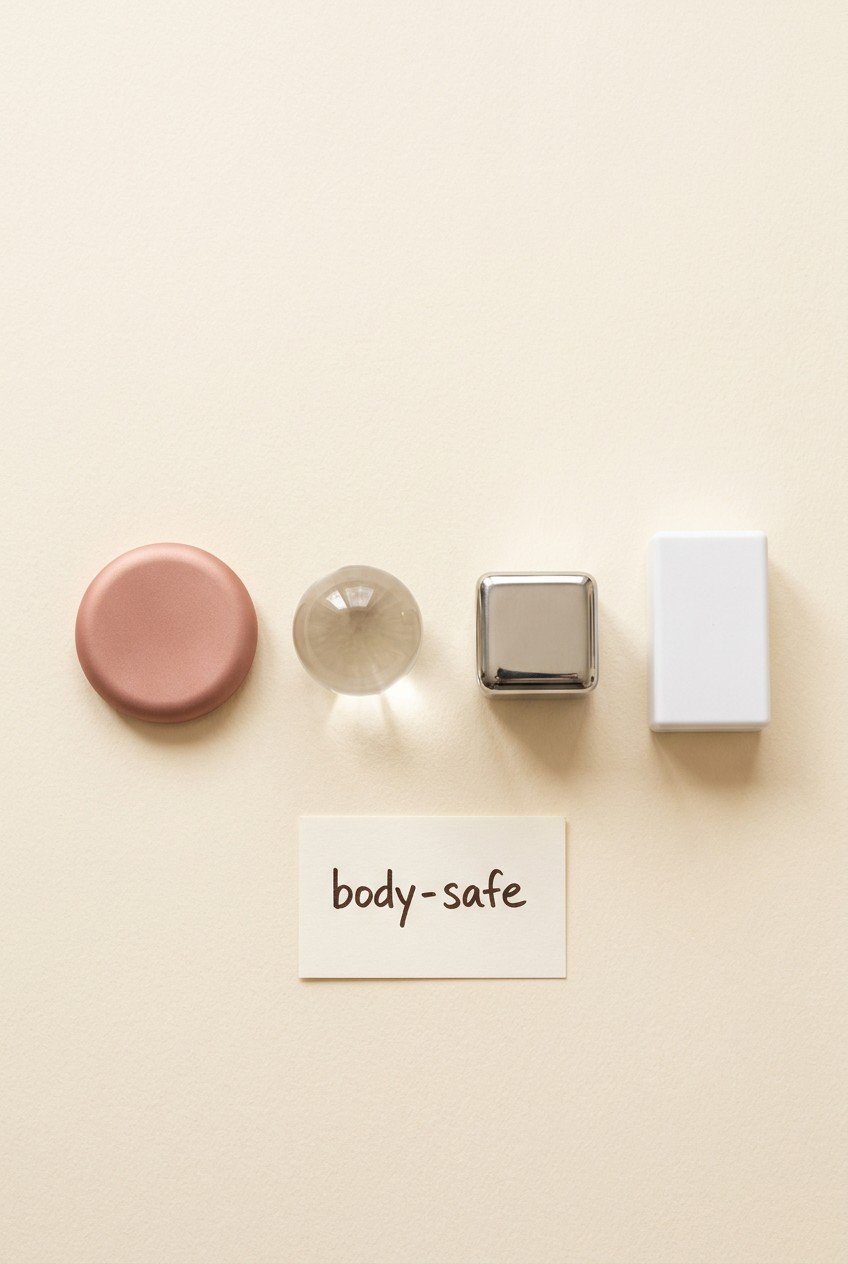
The good news: the information is available. Non-porous, chemically stable materials exist at every price point from 35to200+. The four safe materials — medical-grade silicone, ABS plastic, borosilicate glass, and surgical stainless steel — cover every toy type, every budget, and every preference. You don’t need to compromise safety for sensation. You need to know what you’re looking at.
Your body is worth the $15 difference between TPE and silicone.
Looking for the safe stuff? Every toy in our vibrator collection is medical-grade silicone, BPA-free ABS, or borosilicate glass. No TPE. No PVC. No mystery materials. We list every material on every product page because we believe you have the right to know what you’re buying. No trade secrets. Just silicone.
About the Author:
Dr. Yuki Tanaka is a sexual health educator and clinical researcher at AmorSerere. With a PhD in human sexuality, she has spent a decade translating medical research into the kind of practical guidance that should have been included in sex education but wasn’t. She believes that knowing what your sex toys are made of is not a niche interest — it’s a basic consumer right.
Last Updated: July 20, 2026

Clinical sex educator with 10+ years experience. Specializes in body-safe materials and sexual wellness education.